ponytail
DietrichGebert · DietrichGebert/ponytail
Một kỹ năng hoặc prompt hướng dẫn các tác nhân AI viết mã tối thiểu, hiệu quả, cải thiện chất lượng mã, giảm chi phí và tăng tốc phát triển.
Makes your AI agent think like the laziest senior dev in the room. The best code is the code you never wrote.
Xem kết quả thực tế
Ảnh từ README của tác giảPhân tích chi tiết và báo cáo lỗi do ponytail-review tạo ra
Ảnh từ README của tác giả DietrichGebert ·Nguồn
Bạn có thể làm gì với nó
- Dạy tác nhân AI đơn giản hóa các codebase phức tạp bằng cách tập trung vào sự rõ ràng và súc tích.
- Tối ưu hóa mã do tác nhân tạo ra để có hiệu suất tốt hơn và sử dụng token ít hơn bằng cách tránh sự phức tạp không cần thiết.
- Tự động áp dụng nguyên tắc YAGNI vào phát triển tính năng mới, đảm bảo chỉ viết mã cần thiết.
Thử hỏi agent của bạn
- “Tái cấu trúc hàm này để ngắn gọn hơn và tuân thủ nguyên tắc YAGNI.”
- “Triển khai form đăng nhập, đảm bảo mã tối thiểu và không có thư viện không cần thiết.”
- “/ponytail ultra: Tối ưu hóa toàn bộ module để đạt hiệu quả và đơn giản tối đa.”
Kiểm tra an toàn
Không thấy dấu hiệu rủi ro trong các file đã quét.
Quét tự động các file trong repo. Luôn xem lại code trước khi chạy.
Trích từ README
Ponytail
He says nothing. He writes one line. It works.
Ponytail 5: rebuilt from the ground up. -53% code · -41% time · -26% cost · -45% tokens And yet: 98% of risky logic ships with a test. Without Ponytail: 68%. Benchmarked in Claude Code, the same agent with and without the skill: 39 tasks including a real FastAPI + React repo, Opus 5.5, 5 runs each. Details.
Español · 한국어 · 简体中文 · 日本語
Already built with Ponytail
You know him. Long ponytail. Oval glasses. Has been at the company longer than the version control. You show him fifty lines; he looks at them, says nothing, and replaces them with one.
Ponytail puts him inside your AI agent.
Numbers
Two things the chart does not show: in a blind comparison, Ponytail 5's replies beat the previous Ponytail's 110 to 67. And on the six security tasks (SQL injection, path traversal, forged tokens, rate limiting, malformed CSV rows, caching) it passed all 30 runs: less code, no less safe. Method, per-task tables and limits: benchmarks/results/2026-10-07-agentic.md.
The rule was never "fewest tokens." It is: write only what the task needs, and never cut validation, error handling, security, or accessibility. The code ends up small because it is necessary, not golfed. Lower cost and latency are a side effect.
Before / after
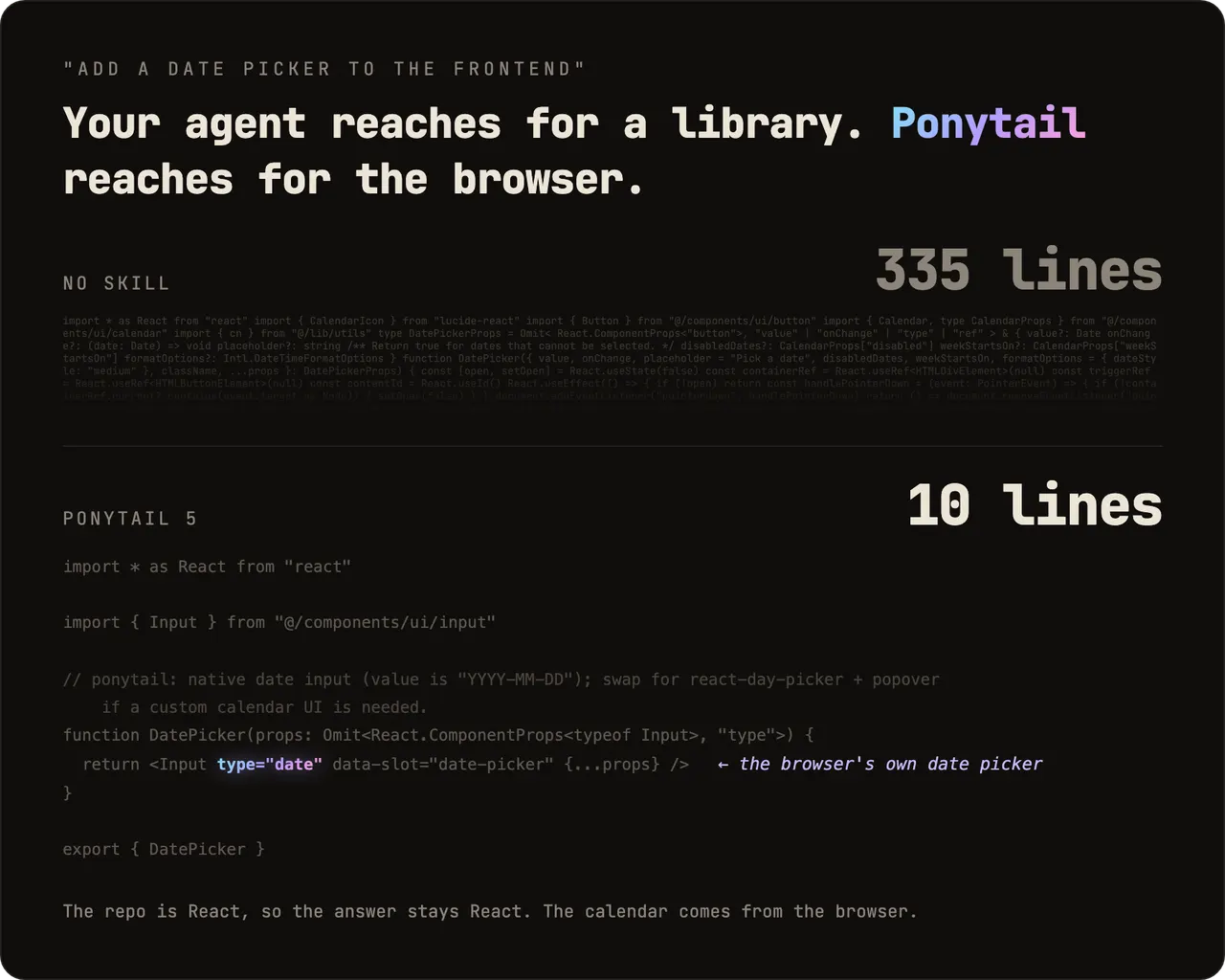
You ask for a date picker. Without Ponytail, the agent installs a date picker library or builds a whole calendar by hand: 335 lines. Ponytail 5 first looks at what is already there: the repo has an Input component, and every browser has a date picker. It puts the two together. 10 lines.
More survivors in examples/.
The review, rebuilt
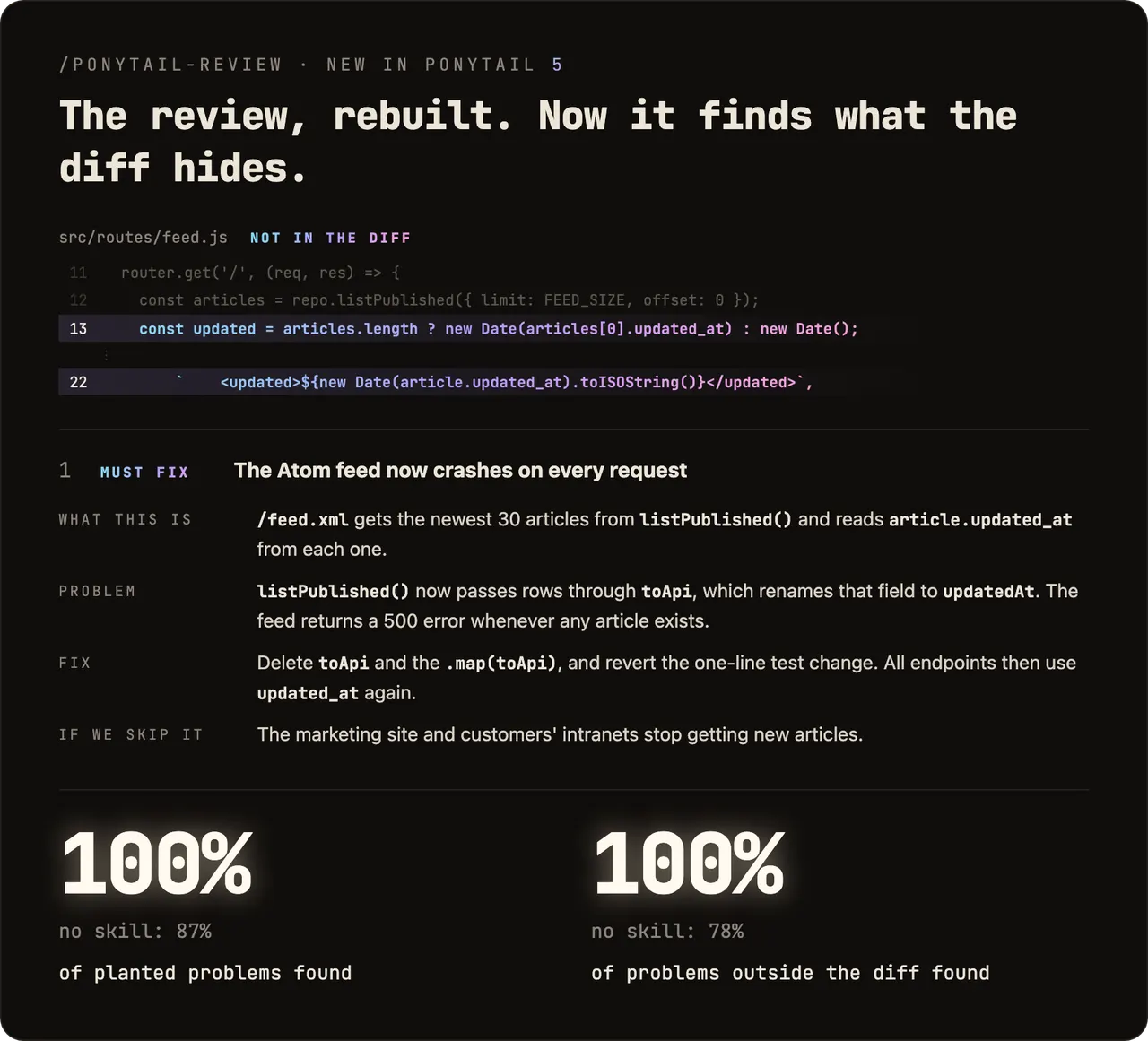
/ponytail-review used to look only for code to cut. Now it reviews like the senior dev who gets paged when it breaks: it reads the code your change touches, not just the diff, and checks bugs, security, real load, missing tests, speed, and what to cut. Each finding says what the code does, what goes wrong, how to fix it, and what happens if you don't.
The audit, rebuilt
/ponytail-audit runs the same checks on the whole repo. It maps the code first: entry points, how data moves, what load the project expects. Then it ranks what it finds and tells you what to fix first. The old audit only listed what to delete.
How it works
The ladder runs after it understands the problem, not instead of it: it reads the code the change touches and traces the real flow before picking a rung. Lazy about the solution, never about reading.
Lazy, not negligent: trust-boundary validation, data-loss handling, security, and accessibility are never on the chopping block.
Logic with a branch, a loop, a parser, money or security leaves one small test behind. Every reply ends with what was skipped or not checked and any risk you should know.
The prompt
Ponytail is one prompt: skills/ponytail/SKILL.md. The compact version, for agents that read a rules file, is AGENTS.md. Everything else in this repo loads that prompt into different agents.
Install
Claude Code, as two separate prompts:
/plugin marketplace add DietrichGebert/ponytail
/plugin install ponytail@ponytail
Codex:
codex plugin marketplace add DietrichGebert/ponytail
codex plugin add ponytail@ponytail
Then open /hooks in Codex, trust its two lifecycle hooks, and start a new thread.
Any other agent: copy AGENTS.md into your project, or ask your agent to install skills/ponytail/SKILL.md as a skill. Step by step for Copilot, Cursor, OpenCode, Gemini and the rest: INSTALL.md.
That was it. He'd be proud. He won't say it.
Active every session, with a handful of commands (see Commands). /ponytail ultra exists for when the codebase has wronged you personally. Startup and mode-change text shows the current mode.
Only install ponytail from DietrichGebert/ponytail on GitHub or @dietrichgebert/ponytail on npm. It never ships .exe or .dll files; a copy that does is not mine.
Commands
| Command | What it does |
|---|---|
/ponytail [lite | full | ultra | off] | Set the intensity, or turn it off. No argument switches ponytail on at the default level if it is off, and otherwise reports the current level. |
/ponytail-review | Review the current diff like the senior dev who gets paged when it breaks: bugs, security, real load, risky code without a test, slow paths, and what to cut. Each finding says what the code does, what goes wrong, how to fix it, and what happens if you don't. Name a target in plain words to narrow or widen it: uncommitted, staged, branch, or a PR link. |
/ponytail-audit | The same check for the whole repo, most important first. |
/ponytail-debt | Harvest the shortcut: comments you've deferred into a ledger, so "later" doesn't become "never". |
/ponytail-gain | Show the measured impact scoreboard (less code, less cost, more speed) from the benchmark. |
/ponytail-help | Quick reference for the commands above. |
Commands need a skill-capable host (Claude Code, Codex, Devin CLI, OpenCode, Gemini, Antigravity CLI, pi, Hermes Agent, Qoder, Grok Build). In Codex CLI and the IDE extension they're skills under the plugin's namespace; invoke with $ponytail:ponytail-review. Cursor with the hooks gets /ponytail level switching only, typed as a plain message. The instruction-only adapters (Cursor's rule file, Windsurf, Cline, Copilot, Kiro, Antigravity's AGENTS.md fallback) load the always-on ruleset without the commands.
FAQ
Does it need a config file? No. An optional `~/.config/ponytail/config