fastapi_mcp
tadata-org · tadata-org/fastapi_mcp
This tool exposes existing FastAPI endpoints as Model Context Protocol (MCP) tools, complete with authentication, allowing AI agents to interact with your backend.
Expose your FastAPI endpoints as Model Context Protocol (MCP) tools, with Auth!
See it in action
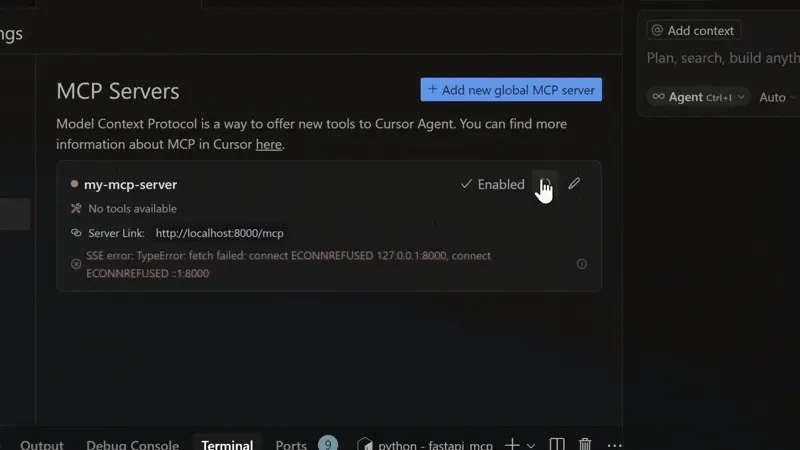
From the author's READMEFastAPI-MCP server integration in Cursor IDE
From the author's README tadata-org ·Source
What you can do with it
- Allow Claude to call custom data retrieval endpoints from a FastAPI backend.
- Securely enable AI agents to perform data modifications via authenticated FastAPI APIs.
- Integrate existing FastAPI microservices into an AI agent's toolset without rewriting them.
Safety check
No risky patterns found in the files we scanned.
Automated scan of the repo files. Always review code you run.
From the README
Built by Tadata
FastAPI-MCP
Expose your FastAPI endpoints as Model Context Protocol (MCP) tools, with Auth!
Features
-
Authentication built in, using your existing FastAPI dependencies!
-
FastAPI-native: Not just another OpenAPI -> MCP converter
-
Zero/Minimal configuration required - just point it at your FastAPI app and it works
-
Preserving schemas of your request models and response models
-
Preserve documentation of all your endpoints, just as it is in Swagger
-
Flexible deployment - Mount your MCP server to the same app, or deploy separately
-
ASGI transport - Uses FastAPI's ASGI interface directly for efficient communication
Hosted Solution
If you prefer a managed hosted solution check out tadata.com.
Installation
We recommend using uv, a fast Python package installer:
uv add fastapi-mcp
Alternatively, you can install with pip:
pip install fastapi-mcp
Basic Usage
The simplest way to use FastAPI-MCP is to add an MCP server directly to your FastAPI application:
from fastapi import FastAPI
from fastapi_mcp import FastApiMCP

app = FastAPI()

mcp = FastApiMCP(app)

# Mount the MCP server directly to your FastAPI app
mcp.mount()
That's it! Your auto-generated MCP server is now available at https://app.base.url/mcp.
Documentation, Examples and Advanced Usage
FastAPI-MCP provides comprehensive documentation. Additionaly, check out the examples directory for code samples demonstrating these features in action.
FastAPI-first Approach
FastAPI-MCP is designed as a native extension of FastAPI, not just a converter that generates MCP tools from your API. This approach offers several key advantages:
-
Native dependencies: Secure your MCP endpoints using familiar FastAPI
Depends()for authentication and authorization -
ASGI transport: Communicates directly with your FastAPI app using its ASGI interface, eliminating the need for HTTP calls from the MCP to your API
-
Unified infrastructure: Your FastAPI app doesn't need to run separately from the MCP server (though separate deployment is also supported)
This design philosophy ensures minimum friction when adding MCP capabilities to your existing FastAPI services.
Development and Contributing
Thank you for considering contributing to FastAPI-MCP! We encourage the community to post Issues and create Pull Requests.
Before you get started, please see our Contribution Guide.
Community
Join MCParty Slack community to connect with other MCP enthusiasts, ask questions, and share your experiences with FastAPI-MCP.
Requirements
- Python 3.10+ (Recommended 3.12)
- uv
License
MIT License. Copyright (c) 2025 Tadata Inc.