llm-wiki-compiler
atomicstrata · atomicstrata/llm-wiki-compiler
Compiles raw source materials into an interlinked knowledge wiki, enabling LLMs and AI agents to access and utilize structured information.
The knowledge compiler. Raw sources in, interlinked wiki out. Inspired by Karpathy's LLM Wiki pattern.
See it in action
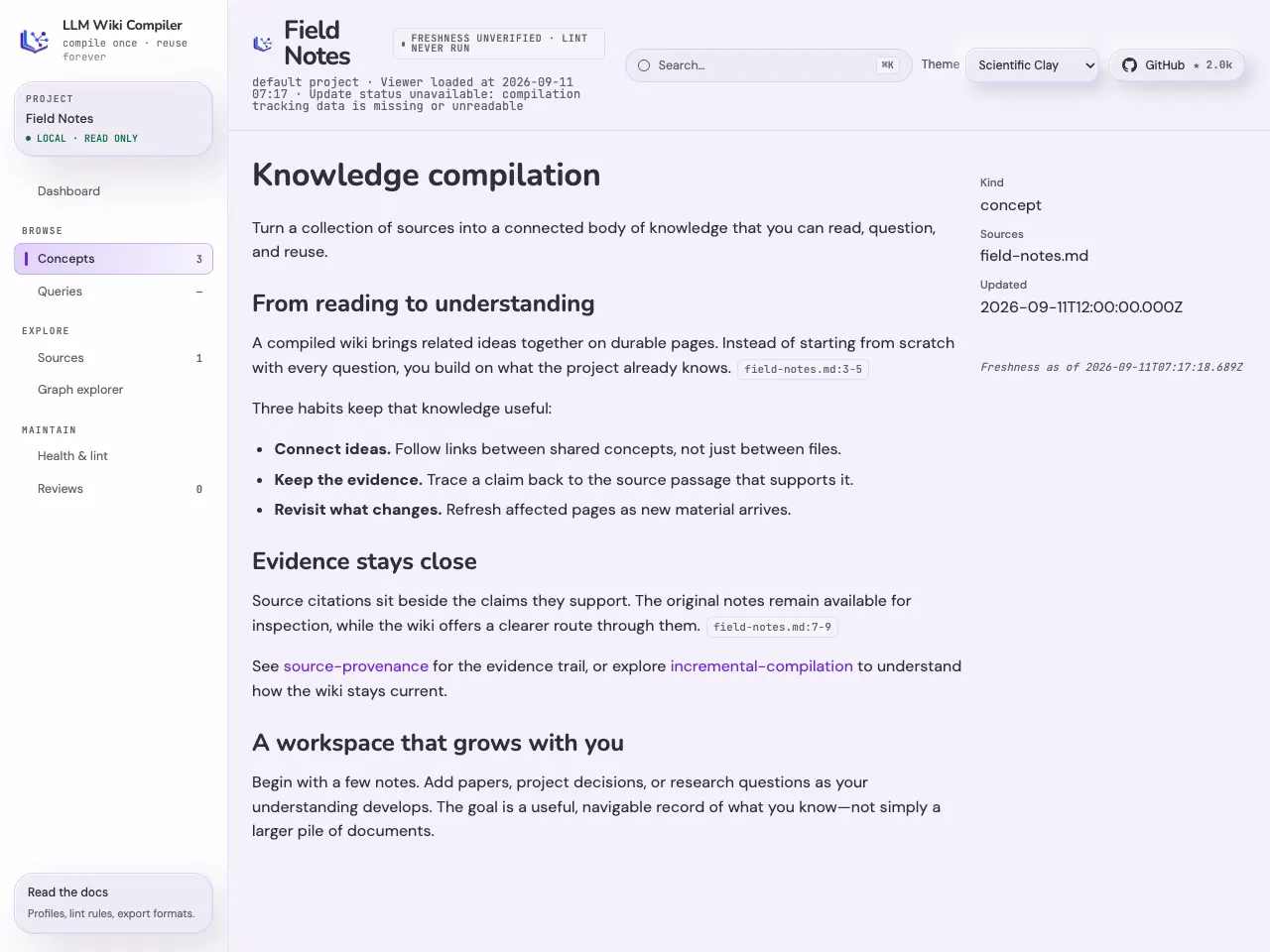
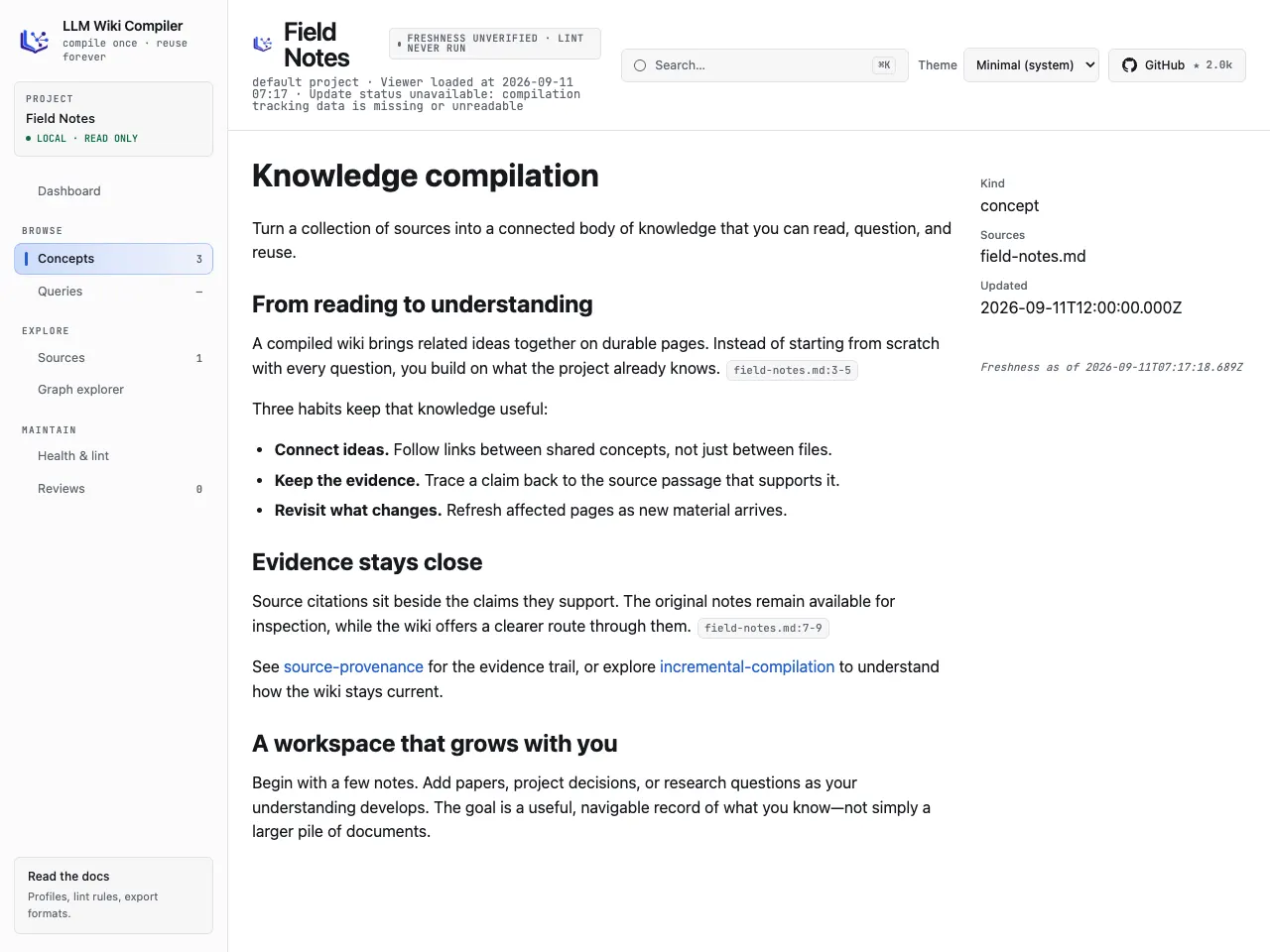
From the author's READMECompiled wiki page interface showing cited knowledge and source tracking
From the author's README atomicstrata ·Source
What you can do with it
- Create a searchable knowledge base from scattered documents for an agent to reference.
- Compile project documentation into a wiki format for AI code assistants.
- Review and publish AI-generated answers as structured pages in a knowledge system.
Safety check
No risky patterns found in the files we scanned.
Automated scan of the repo files. Always review code you run.
From the README
llmwiki
New in 1.4.0 — Review answers before publishing.
- Choose what becomes part of your wiki. Review generated answers and check their citations before saving them as published pages.
- Approve pages together. Review a batch of generated pages and publish the ones you choose in one operation.
- See the pages behind an answer. Follow citations back to your wiki and see which pages were used to answer your question.
Release notes · Upgrade guide · Install llmwiki
New in 1.3 — A fresh look for your wiki.
Meet Scientific Clay, with soft surfaces and rounded typography, and Minimal, which follows your system’s light or dark setting. Switch instantly between four themes, including Nebula Light and Dark.
Scientific ClayMinimal
The same page in a demonstration wiki. Click either screenshot for a closer look.
Recursive source folders, path exclusions, project-specific compile instructions, and storage for larger embedding indexes.
New in 1.2 — Explore your records and their evidence.
Browse profile-defined categories, declared fields, connected records, provenance, and supporting source passages in the local viewer.
New in 1.1 — Publish and share domain templates.
Create signed template distributions, discover them through explicitly trusted catalogs, and install or update them with compatibility checks.
New in 1.0 — Configurable Lifecycle Profiles.
Build a knowledge system around the way you work. Define your records, relationships, review gates, and workflows in one validated profile. Start with AutoSci for research or Newsroom for editorial work, or create your own.
Explore Configurable Lifecycle Profiles →
What llmwiki does
Compile raw sources into an interlinked, citation-traceable markdown wiki that agents and humans can browse, query, lint, export, and reuse. The default profile preserves the classic concepts-and-queries layout; optional profiles add domain-specific types and workflows without adding domain branches to the compiler.
llmwiki implements the LLM Wiki pattern: instead of re-discovering knowledge from raw files at query time, compile it once into durable pages that accumulate structure, provenance, review state, and retrieval metadata over time.
When to use this repo
Use llmwiki when you need a persistent knowledge base from raw material:
- Compile papers, notes, READMEs, transcripts, PDFs, images, or web pages into typed wiki pages.
- Give agents a stable, citation-aware context pack instead of a pile of loose files.
- Keep generated knowledge auditable with source citations, review queues, freshness checks, and quality gates.
- Browse the result locally, query it from the CLI, expose it over MCP, or embed it through the SDK.
- Exchange compiled knowledge with other tools using Open Knowledge Format (OKF), JSON, JSON-LD, GraphML, Marp, and
llms.txt.
Do not use llmwiki as a general static-site generator, a heavy ontology database, or a replacement for ad-hoc search over fast-changing raw logs. It is strongest when source knowledge is worth compiling, reviewing, and reusing.
What you get
- Compiled wiki, not chunks. A two-phase LLM pipeline extracts concepts, then generates typed pages:
concept,entity,comparison, andoverview. - Configurable Lifecycle Profiles. A fail-closed
.llmwiki/profile.jsoncan declare entity schemas, typed relations, lifecycle state machines, transition requirements, workflows, artifacts, connectors, content tiers, and retrieval policy. - Installable domain templates.
llmwiki template init autoscicreates a research project with papers, ideas, experiments, manuscripts, evidence artifacts, workflows, and Crossref import.newsroomdemonstrates the same machinery for editorial work. - Runtime trust gates. Relation, evidence, artifact, and human/agent gates are enforced by the write path rather than left as prompt conventions; standing lint detects drift after the fact.
- Citation-traceable output. Paragraphs and claims cite source files and line ranges, and
llmwiki lintvalidates the links. - Hybrid retrieval. Semantic chunk search, BM25 reranking, and wikilink graph expansion build compact evidence packs for queries and agents.
- Local viewer.
llmwiki viewopens a read-only browser UI with search, page metadata, graph exploration, source-freshness badges, and citation chips. - Review policy. Generated pages can be auto-held for review when confidence, contradiction, schema, or provenance rules trip.
- Freshness repair.
llmwiki lintandllmwiki nextsurface stale/orphaned pages;llmwiki refresh --stalerepairs changed knowledge without compiling unrelated new sources. - Eval harness.
llmwiki evalreports health score, a per-page health distribution that flags the worst pages, wikilink-graph health, citation coverage/precision, corpus stats, regression deltas, and optional judge-model citation support. - MCP server.
llmwiki serveexposes ingest, compile, query, lint, read, status, eval, context-pack, and OKF exchange tools to MCP-compatible agents. - SDK.
createWiki({ root })drives ingest, compile, query, context, status, export, eval, and OKF import/export from TypeScript without shelling out. - Open Knowledge Format exchange. Export and import OKF bundles for portable, markdown-native knowledge exchange. External OKF imports are staged through the review queue by default; trusted bundles can be written live explicitly.
- Other portable exports. Export JSON, JSON-LD, GraphML, Marp slides, and
llms.txtfor downstream systems. - Provider portable. Anthropic, Claude Agent SDK local login, OpenAI Codex CLI local login, OpenAI-compatibl